A reader submits:
Assuming all things constant and taking this illustration very simply (ignoring PP, MA, candlestick, etc), I appreciate your advice on whether my entry (dotted blue) would be correct. I also have 2 scenarios which I don't know how to deal with.
Just to clarify, when you talk about 2 NRIBs, does the 2nd NRIB have to be inside the 1st NRIB as well?

The two easiest scenarios to address are i) and v). These are excellent setups assuming that price is above and, in very close proximity to the 5 period ema. It's also of utmost importance that volume contracts during the inside bars. Refer to my
initial post on the topic. Item v) addresses the last point in that the second IB
does not have to be inside the first.
Items ii) and iii) are a little more subjective and may require more confirmation. For example, if ii) is part of a flat base, I would wait until price takes out the first bar or the shadows as may be the case. If bar 3 is red, I wouldn't take the entry off of this time frame. I would drill down and look for a candlestick reversal pattern on a lower time frame. The RIMM example below, although not exactly as depicted in the chart above is somewhat similar and makes the point.
The first chart is the 15 min. and the second is the 5. See how the lower timeframe provides clarity as to what is really going on, whereas the 15 minute chart is somewhat ambiguous.


Item iii) is a good example of a triangle formation and if that is in fact what it looks like on the lower time frame, then this is the correct entry. If bar 1 is the OR and there is no resistance above including an intra day PP, then I would trade it as presented in the example. The only caveat is that until the ORH is taken out, there's always a risk. So if the ORH is only pennies away, I sometimes wait for confirmation. On the other hand, if the 2nd IB is NR7, the setup becomes all that more powerful and may not require confirmation. If you take the entry as presented, you generally have enough room to exit at or near BE if the pattern fails. It's a judgment call and you will determine which entry suits your trading style best over time.
Item vi) is a bullish flag or flag pole and should be entered on break of the flag. When drawing the line segment for the flag make sure to include the upper shadows.
Item iv) is subjective again. I often wait until price takes out bar 1 because the 5 period ema is too far away and I'm waiting for it to catch up to price. This pattern often comes up in the handle portion of the C&H pattern, and here again, I wait until price takes out bar 1. That's my personal preference and it saves me from taking trades that don't pan out, or reverse just prior to breaking out.
Here is an example of a trade with RMBS that I took a while back which depicts the same formation as item iv). As you can see from the first 15 minute chart, the 5 period ema was still quite a distance from price, so I set my buy stop order above the outside bar.
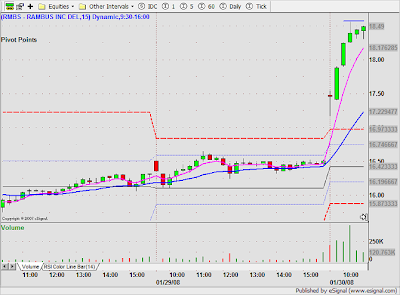

If the inside bars set up at the base of a PP or at a resistance level (for long entries as depicted above), a successful break will generally result in a big move. The best setups are the ones that give consecutive higher lows, so in that respect I prefer i), iii), and v), everything else being equal.
MarketClub Education Page Click Here
 CNQ gapped up and held the daily pivot high from the last two sessions on a closing basis as it consolidated the gap sideways. It printed a series of higher lows. The fifth bar was NR7 and finally, it carved out a perfect green hammer which closed at the base of all those inside bars. I entered long and it started out perfectly then consolidated sideways again like a stair step pattern, before the next leg up. I took a partial at the 50% Fib. extension of the previous day low to the ORH. It extended 100% before retracing - Sweet!
 I had high hopes for AAPL going into the session, but was not inspired by the early price action. I took a second look after Anarco mentioned it. Long on break of $130.00. Partial after 3 consecutive full green sticks. Stopped out on balance at $31.50.
 A really good day!


